

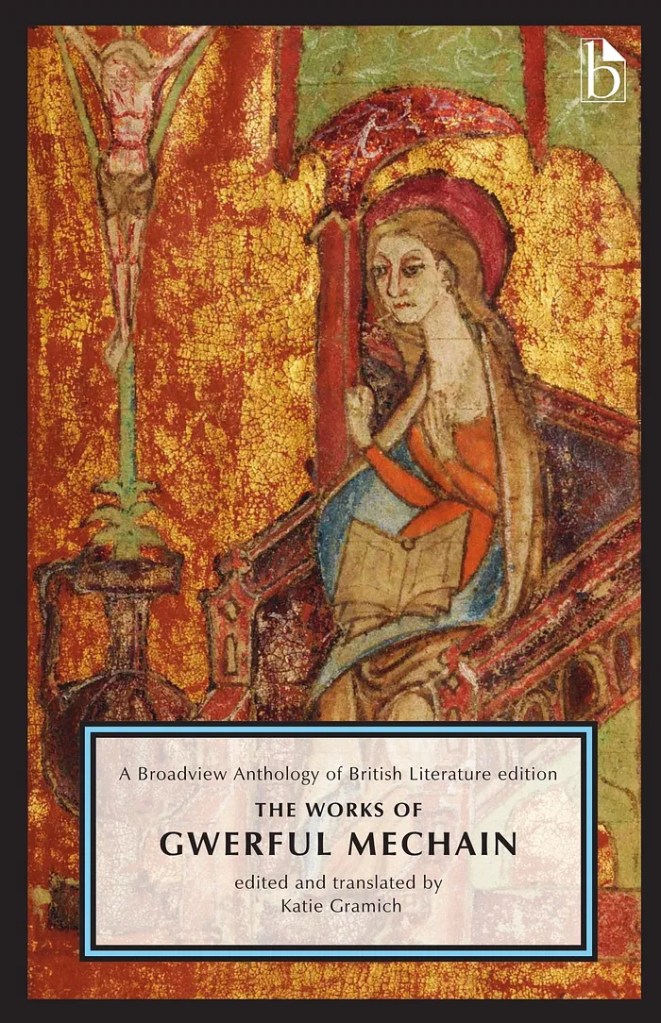
Gwerful Mechain was one of very few medieval female poets. Her work stands out with great contemporary relevance, as her poetry appears like they could have been written today. Gwerful proved her intelligence and poetic skill in her devotional poetry, making her equal to her male counterparts.1
It is only in recent years that Gwerful Mechain has started to receive the attention she deserves. In the nineteenth century, she was frequently dismissed as a prostitute, since the sexual nature of her poetry was deemed inappropriate, ‘on the grounds that it is salacious’.2 As a result, her poetry was not included in any anthologies during that time.3
She composed her poetry in unconventional ways once she had proven her skill in the traditional poetic craft. She often used male poets’ works as her inspiration to produce a distinctly female perspective and challenge the poetic and social norms of the time.
In To The Vagina, Gwerful used Dafydd ap Gwilym’s Poem to the Penis as the basis for her work, expressing her disgust at male poets for ignoring the beauty of a woman’s vagina and only focussing on her outer beauty, even suggesting the ways in which they could describe the vagina, as a tutor figure to her male counterparts.
they should embrace the vagina as a subject in their love poetry, rather than ignore it:
But he leaves the middle without praise.
That place where children are conceived,
The snug vagina, clear hope,
Tender and lovely, open circle strong and bright,
The place I love, delicate and healthy,
The quim beneath the cloth.4
This part of the poem implies Gwerful’s frustration at male poets for not praising the beauty of the vagina. Despite it being a fun and sexual poem, it is also full of feminist remarks, that women should not just be seen as beautiful in their faces and breasts, but also in their genitalia.
Gwerful was forward thinking for her time, standing up for womankind in To Her Husband For Beating Her and in her response to Ieuan Dyfi’s scornful poem about Anni Goch. In these poems she followed poetic convention, getting across the serious nature of the subject and her passion for speaking out against women’s inequality. She served a greater purpose than simply mocking other poets by using the poetic craft to match and even exceed their wit, fighting against the social norms and planting ideas that were modern even by today’s standards.
Overall, Gwerful was an exceptional poet, able to adapt the poetic techniques of the time to carry her feminist message, sometimes playfully and at other times in a very serious tone. Both in historical and contemporary terms, Gwerful Mechain was a true feminist and stood up for women at a time when it was unacceptable, seeing no option but to be the female voice amongst the multitude of male voices.
- Nerys Howells, ‘Gwerful Mechain’, in The Celts: History, Life And Culture: A-H, ed. by John T. Koch (California: ABC CLIO, 2012), pp. 400-401 (p. 401). ↩︎
- Carolyne Larrington, Women and Writing In Medieval Europe: A Sourcebook (London: Routledge, 1995), p. 72. ↩︎
- Ceridwen Lloyd-Morgan, ‘Women And Their Poetry In Medieval Wales’, in Women And Literature In Britain 1150 – 1500, ed. by Carol M. Meale, 2nd edn. (Cambridge: Cambridge University Press, 1996), pp. 183-201 (p. 194). ↩︎
- Katie Gramich, The Works Of Gwerful Mechain (Ontario: Broadview Press, 2018), p. 43. ↩︎
You can find more information on Gwerful Mechain’s biography on Dictionary of Welsh Biography. For an article on her contribution, see Scroll.in. Medievalists.net also has a good article.
 Bethan Jones